
Line of sight

Line of sight is a game mechanic in the Bloons TD series introduced in Bloons TD 6, it restricts the directions where towers can attack Bloons due the presence of certain map features such as walls, environmental objects and changes in terrain elevation.
This game mechanic is implemented in the following games:
Mechanics
The line of sight of a tower is the area of the map where towers can detect Bloons and target them for attacks. For most towers in the Bloons TD series, this area is indicated by a semi-transparent blue highlight (other colors such as white or cyan can be used depending on the accessibility settings) which is visible when a tower is selected. However, in specific scenarios, towers might be prevented from attacking on certain directions due the presence of obstacles known as line of sight blockers, and if present inside a tower's display range, the blocked areas will be highlighted with red (or black, again depending on accessibility settings).
The choice between different targets (targeting option) will only consider Bloons in the tower's line of sight and is checked in the frame where the attack would start, then, attacks and projectiles will continue moving as normal even if the intended target exits the line of sight. Specific line of sight mechanics depend not only on the tower, but also on the specific attack they are performing, which can be broadly classified on several categories:
Regular towers and attacks
For most towers, the line of sight of is a sub-region of the tower's display range where and will attack Bloons whose hitbox intersect with it. Map features that can create line of sight blockers include:
- Terrain height: Every attack has a determined height value from where the projectiles are spwaned, which in a 3D-enviroment corresponds to the Z-axis with positive direction is pointed towards the screen/player. Towers are able to see and target Bloons if the terrain where they stand from has a lower or equal height than the height value of the attack plus the height value of the terrain where the tower is standing.
- Walls and environmental objects: These are permanent map structures that completely block the sight of a tower and their presence is commonly used as way to increase the difficulty of a map.
- Removables: Some maps contain objects that act as line of sight blockers, but can be removed by paying a certain amount of cash.
Usually, projectiles of these towers will also be destroyed if they collide with a line of sight blocker, but other projectiles can continue traveling and hit other Bloons behind cover, even if they are not the intended target. Certain towers may also have the innate capability (or be granted by an upgrade) to bypass all of these line of sight blockers and have their line of sight being equal to their display range, (e.g. Adora or the Guided Magic upgrade for Wizard Monkeys in both BTD6 and BTDB2).
For these towers, their line of sight is the remaining portion of their display range that was not obscured by line of sight blockers. Towers in this category will only attack Bloons if the following 3 conditions are true:
- Any portion of the Bloon's hitbox is inside the display range of the tower.
- The entirety of the Bloon's hitbox is not covered by a line of sight blocker.
- The tower is not prevented from attacking the Bloon by other factors (e.g. Camo property).
-
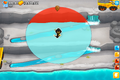 The map Quarry in BTD6 has three platforms with different heights, towers in the middle one are prevented from attacking Bloons in the higher platform, even if a Bloon is inside their display range, but they can attack towards the lower one.
 -
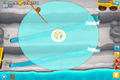 Certain towers ignore line of sight blockers and attack Bloons despite height differences, walls, map objects or removables.
 -
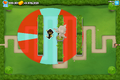 The line of sight of this tower is mostly blocked by the wall placed in its left and right side, so it can only shoot up and down and through a small gap in the left one.
 -
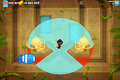 Environmental objects and removables also block a tower's line of sight. Despite the MOAB being inside the display range, the tower cannot attack it because its vision is obscured by the statues.
 -
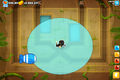 Certain maps allow the removal of line of sight blockers, allowing towers to attack after paying some cash.


Flying towers
Certain towers can bypass the line of sight blockers by flying over the map, and in this case, their line of sight is independent from their display range, shown in the tower's base. For actually attacking the Bloons some towers (e.g. Monkey Ace) will continuously attack, even if there are no Bloons nearby, and others (e.g. Heli Pilot) will only start attacking when Bloons are present inside a "detection area" with is a circle with a certain radius, centered on the flying unit and traveling alongside it. The projectiles of these towers can hit any valid target regardless of the terrain height or obstacles in the way and won't be destroyed by any blocker.
The line of sight of flying towers is their detection range, which can be of a specific radius, or even have map-wide reach. Towers in the detection range sub-category will only attack Bloons if the following 2 conditions are true:
- Any portion of the Bloon's hitbox is inside the detection range of the flying unit.
- The tower is not prevented from attacking the Bloon by other factors.
-
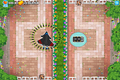 Flying towers can bypass line of sight blockers, the main attack of Monkey Aces will fire continuously, even if no Bloons are nearby, and their projectiles won't be destroyed even if they hit a blocker, like the wall in the center.
 -
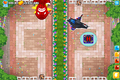 Other flying towers will only attack Bloons if they are close to them, which is limited by an invisible circle-shaped area which is centered and moved around with the flying unit.
 -
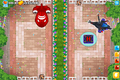 If the Bloon is outside the detection zone, it won't be attacked by flying towers.


Global range towers and attacks
Other towers are capable of targeting and attacking Bloons outside their display range, extending their own line of sight in all directions, sometimes even map-wide. Sniper Monkeys are the most common example, they can attack to any location in the map as long they are not impeded by line of sight blockers. For these kind of towers, areas where the tower can attack are not highlighted while the tower is selected (except their display range), but the blocked areas will be highlighted in red. On the opposite side, towers like Psi also have global range, but their line of sight is not affected by obstacles and can attack map-wide.
The line of sight of towers with global range that are affected by blockers will be any portion of the map that would not be obscured by the blockers (visualized by the red highlighted areas when the tower is selected) and for the towers that ignore the blockers, their line of sight is the entire map. Towers in this category will only attack Bloons if the following conditions are true:
- It is possible to draw a straight line from the tower's center to any part of the Bloon's hitbox without touching a line of sight blocker. For towers that ignore the blockers, this requirement s not needed.
- The tower is not prevented from attacking the Bloon by other factors.
-
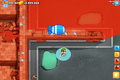 Monkey Snipers are able to attack any Bloon in the map, but they need to have a clear line of sight, in this case the middle wall prevents them from seeing the MOAB, but will start attacking as soon it turns around the corner. In this case, the tower's line of sight does not match its display range.
 -
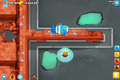 Other towers like Psi can ignore line of sight blockers and attack Bloons anywhere in the map (notice the lack of red zones). In this and the Sniper case, the small circle around the tower is used as the map areas that can be shared with other towers, and not their global range.


Towers with manual targeting
Some towers will only attack continuously towards a point specified by the player, so they bypass the line of sight mechanic entirely, these can be classified in two categories according to their mechanic projectiles:
- Straight shooters: This includes towers like Dartling Gunner or attacks like the Arctic Knight Ice Jet ability, they fire in the general direction specified by the player, but their projectiles will be destroyed (or bounce) upon touching a line of sight blocker or the edge of the map. If given the ability to target Bloons automatically (e.g. Bloon Area Denial System), they will behave like a global range tower with blocker limitations and their line of sight is the same as these kind of towers.
- Lobbed shooters: This includes towers like Mortar Monkey or Spike Factory in the "Set Target" targeting option (via Smart Spikes upgrade), they fire in the general direction specified by the player, but their projectiles will always reach their target, even if set to a location far from the track. If given the ability to target Bloons automatically (e.g. Dynamic Targeting), they will behave like a global range tower without blocker limitations and their line of sight is the same as these kind of towers.
-
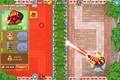 Some towers like Dartling Gunners are able to attack in any direction as the player chooses, but it doesn't mean they can bypass line of sight blockers, which will destroy their projectiles upon contact.
 -
 Mortar Monkeys fire upwards, allowing them to bypass the line of sight blockers and attack anywhere in the map without restrictions.


Shared range attacks
Certain attacks are able to attack Bloons present in the display range of other towers, the most prominent example are Monkey Subs with the Advanced Intel upgrade, which allows them attack towers located far from them, with some limitations, for example, the subs cannot use their main dart attack towards the range of other tower if the sub itself does not have a clear line of sight, but it can use other attacks such as Ballistic Missile even if the range of the other tower is completely inside a blocked zone.
To be able to hit Camo Bloons, the tower that is sharing its range must have Camo detection, even if the far attacking tower is able to see Camo naturally (e.g. Silas). And for flying, global range or manual targeting towers, they are only able to share their small display range.
The line of sight of towers in this category will be the sum of their own line of sight plus the overlap between the display range and line of sight of other towers that can share with them. Towers will only attack Bloons in a shared range area if the following conditions are true:
- Any part of the Bloon's hitbox is both inside the display range and the line of sight of the tower that is sharing their range.
- It is possible to draw a straight line from the attacking tower's center to the portion of the Bloon's hitbox defined by the previous condition without touching a line of sight blocker. For towers that ignore the blockers, this requirement s not needed.
- If the target is a Camo Bloon, the tower that is sharing range needs to have Camo detection.
- The attacking tower is not prevented from attacking the Bloon by other factors.
-
 Monkey Subs with the Advanced Intel upgrade can attack towards the range of other towers, but to use their main dart attack on a distant target, they need to have a clear line of sight, meaning this sub will never attack the Bloons in the range of the left Dart Monkey.
 -
 The line of sight restriction is applied in an attack by attack basis, in this case, if a Monkey Sub has both Advanced Intel and Ballistic Missile upgrades, it will be able to use the Missile to attack Bloons in the range of the left Dart Monkey, but not with its main dart attack.
 -
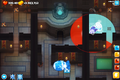 Another example of a shared range tower with line of sight blockers, Silas can attack the MOAB in the range of the Ice Monkey, even if the Ice Monkey itself can't target MOAB-Class Bloons naturally.
 -
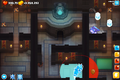 The Ceramic Bloon is inside the Ice Monkey's display range, but not in its line of sight, so Silas is not able to attack it.
 -
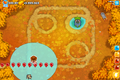 Towers with shared range attacks cannot target Camo Bloons if the tower that is sharing does not have Camo detection. This is also true if the attacking tower has Camo detection itself.
 -
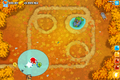 A tower with camo detection sharing its range.


Game-specific mechanics

|
This section is in need of research. You can help out by editing this article or discussing your findings on the talk page. The editor who added this notice elaborates: Add mechanics that are specific to a game, but not covered in the previous section, if any |
Although the feature was not implemented formally until BTD6, certain maps in BTD5 contain tunnels which prevent towers from attacking Bloons if they are inside of them, for example, the map Monkey Lane contains two tunnels which smaller Bloons can use and protects them for a short period of time, but MOAB-Class Bloons are "too big" to enter the tunnels and will fly over them, so they can still be attacked. Sniper Monkeys, Advanced Intel upgrade for Monkey Subs and manual targeting towers are also present in this and all other games of this generation (Battles, Monkey City) and work in a similar way as their counterparts in current generation.
Navigation
| Attack mechanics | ||||||||
|---|---|---|---|---|---|---|---|---|
|